Sleep, steps and mood: what your Apple Health data can tell you
By Maxim Dremin, maker of Dayfuku · Published
The short answer
Studies that follow people day by day find that a night of better sleep than usual tends to come with a better mood the next day, and that people who move more report fewer bad days. Your iPhone already records steps, and sleep if you use an Apple Watch or a sleep app. To see how they line up with your own mood, log your mood regularly, compare each day with your own average rather than with other people, and wait for three or four weeks of data before drawing conclusions.
Your iPhone has probably been counting your steps for years, and if you wear an Apple Watch it knows how you slept last night. What it doesn’t know is how you felt. Put the two side by side and you can start answering a question most people only guess at: does a bad night or a lazy day really change my mood, or does it just feel that way?
What research says about sleep and mood
The link between sleep and mood runs both ways: a bad day can keep you up, and a bad night can ruin the next day. But when researchers follow the same people day after day, the second direction tends to be the stronger one.
In one study, 208 adults rated their sleep every morning and their mood several times a day for six weeks. Nights of better sleep quality than usual were followed by better mood the next day, and that effect was clearly larger than the effect of mood on the following night. It held up after accounting for stress, physical activity measured by the phone, and even the weather.
208 adults
tracked their sleep and mood every day for six weeks
Triantafillou et al., 2019
1 night
of better sleep than usual tended to come before a better day
Triantafillou et al., 2019
Two details from this kind of research are useful when you look at your own data:
- How rested you feel counts too. Some studies find that how well people feel they slept is more closely linked to mood than how long they slept. Hours from a tracker are still a useful starting point.
- Your own normal is what counts. Seven hours may be a great night for one person and a short one for another. What counts is a night better or worse than your usual.
What research says about steps and mood
The evidence for movement comes mostly from comparing people with each other. A 2024 review pooled 33 studies with about 96,000 adults, and a study of 1.2 million Americans compared people who exercised with similar people who didn’t:
7,000+ steps
a day went with about 30% lower risk of depression, in the studies that followed people over time
Bizzozero-Peroni et al., 2024
~9%
lower risk with every extra 1,000 steps a day
Bizzozero-Peroni et al., 2024
1.5 days
fewer days of poor mental health a month, as people reported them, for those who exercised (about 43% fewer)
Chekroud et al., 2018
Both show a link, not cause and effect. People who feel well may simply move more, and other things, like having a dog or a job on your feet, affect both. Still, many people notice in their own journals that a day with a walk feels different from a day on the sofa, and that’s exactly what tracking can show you.
How to compare your own data without fooling yourself
Looking at your own numbers is fun, and it’s easy to see patterns that aren’t there. A few habits keep you honest:
- Compare yourself with yourself. Is your mood better after a night longer than your usual? Not: do you sleep less than the recommended eight hours?
- Look at the right day. Last night’s sleep belongs with today’s mood. Today’s steps can go with today’s mood, but also with tomorrow’s.
- Wait for enough data. Three or four weeks gives you enough short and long nights, and busy and quiet days, to compare. A single week is mostly chance.
- Watch out for weekends. On weekends many people sleep longer, walk more and feel better, and all three may just be the weekend. Compare weekdays with weekdays.
- Look for a trend, not a rule. “I tend to feel better after a long walk” is a useful finding even if it isn’t true every single time.
| What you see | What it could mean | How to check |
|---|---|---|
| Rough mornings after short nights | Sleep really does hit your mood | Try going to bed 30 minutes earlier for two weeks |
| Better mood on high-step days | Moving helps, or good days make you move | Add a short walk on a normal day and compare |
| No link at all | Other things matter more for you right now | Look at activities, people and time of day instead |
| Low mood despite good sleep and steps | Something else is going on | Read your notes from those days; talk to someone if it lasts |
Where the data comes from
Apple Health collects the data, but different things record it:
- Steps are counted by your iPhone on its own, and by an Apple Watch if you wear one.
- Sleep comes from an Apple Watch with sleep tracking turned on, or from a sleep app or tracker that saves to Apple Health.
- Workouts and active energy come mostly from an Apple Watch or a fitness app.
If you only carry an iPhone, steps are the easiest place to start.
Putting it next to your mood in Dayfuku
In Dayfuku, each day can show your steps, last night’s sleep, workouts and active energy from Apple Health next to your check-ins, so you see the whole day in one place (this is part of Dayfuku Pro). Over time, Insights show how your mood compares after longer and shorter nights, and how it lines up with your steps.
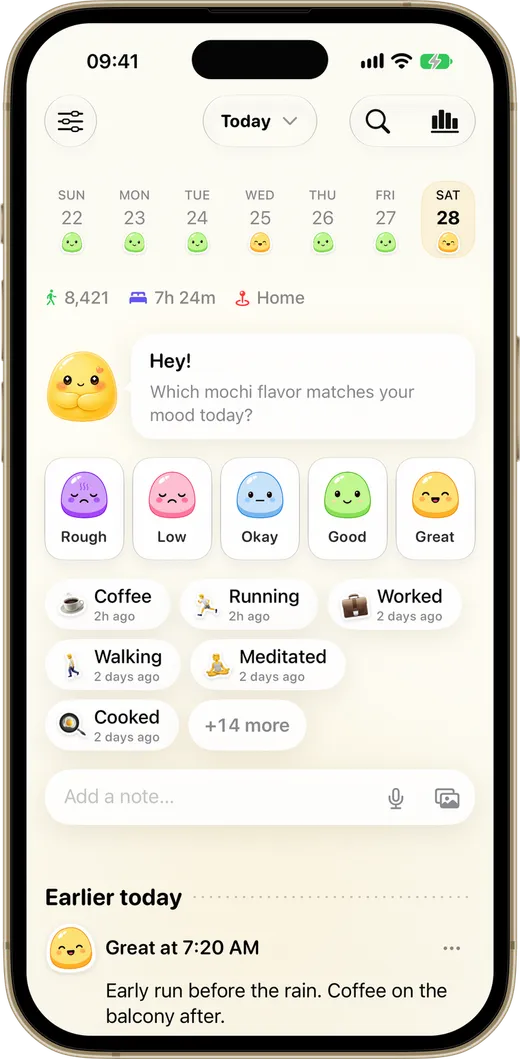

Dayfuku only reads this data. It never writes to Apple Health, keeps everything on your iPhone, and doesn’t have a server that stores your journal. Mood check-ins themselves are free, and you can also check in several times a day, which makes the comparison with sleep and movement much more detailed.
Questions people ask
Does sleep affect mood the next day?
Usually, yes. In a six-week study that tracked 208 adults every day, nights of better sleep quality were followed by better mood, and this effect was larger than the effect of mood on the next night’s sleep.
How many steps a day are good for your mood?
There’s no magic number. In a 2024 review, studies that followed adults over time found that those who walked 7,000 or more steps a day had a lower risk of depression than those who walked fewer, and each extra 1,000 steps came with a little less risk. These studies show a link, not proof that steps cause better mood, and moving a bit more than you usually do is a more useful goal than any fixed target.
Can I see my mood next to my sleep in Apple Health?
Apple Health shows steps and sleep, but it doesn’t put them next to your journal. A mood tracker that reads Apple Health, such as Dayfuku with Dayfuku Pro, shows a day’s steps and sleep next to that day’s check-ins and can point out how they line up.
How long do I need to track to see a link between sleep and mood?
Three to four weeks of regular entries is a good minimum. You need enough short nights and long nights, and enough active and quiet days, to compare them. With only a week, one unusual day can make a pattern look much stronger or weaker than it is.
Sources
- Triantafillou, S. et al. (2019). Relationship between sleep quality and mood: Ecological momentary assessment study. JMIR Mental Health, 6(3), e12613.
- Bizzozero-Peroni, B. et al. (2024). Daily step count and depression in adults: A systematic review and meta-analysis. JAMA Network Open, 7(12), e2451208.
- Chekroud, S. R. et al. (2018). Association between physical exercise and mental health in 1·2 million individuals in the USA between 2011 and 2015: a cross-sectional study. The Lancet Psychiatry, 5(9), 739–746.
This guide is general information, not medical advice. If your mood is low most days, or you’re thinking about harming yourself, please talk to a doctor or contact a local crisis line.